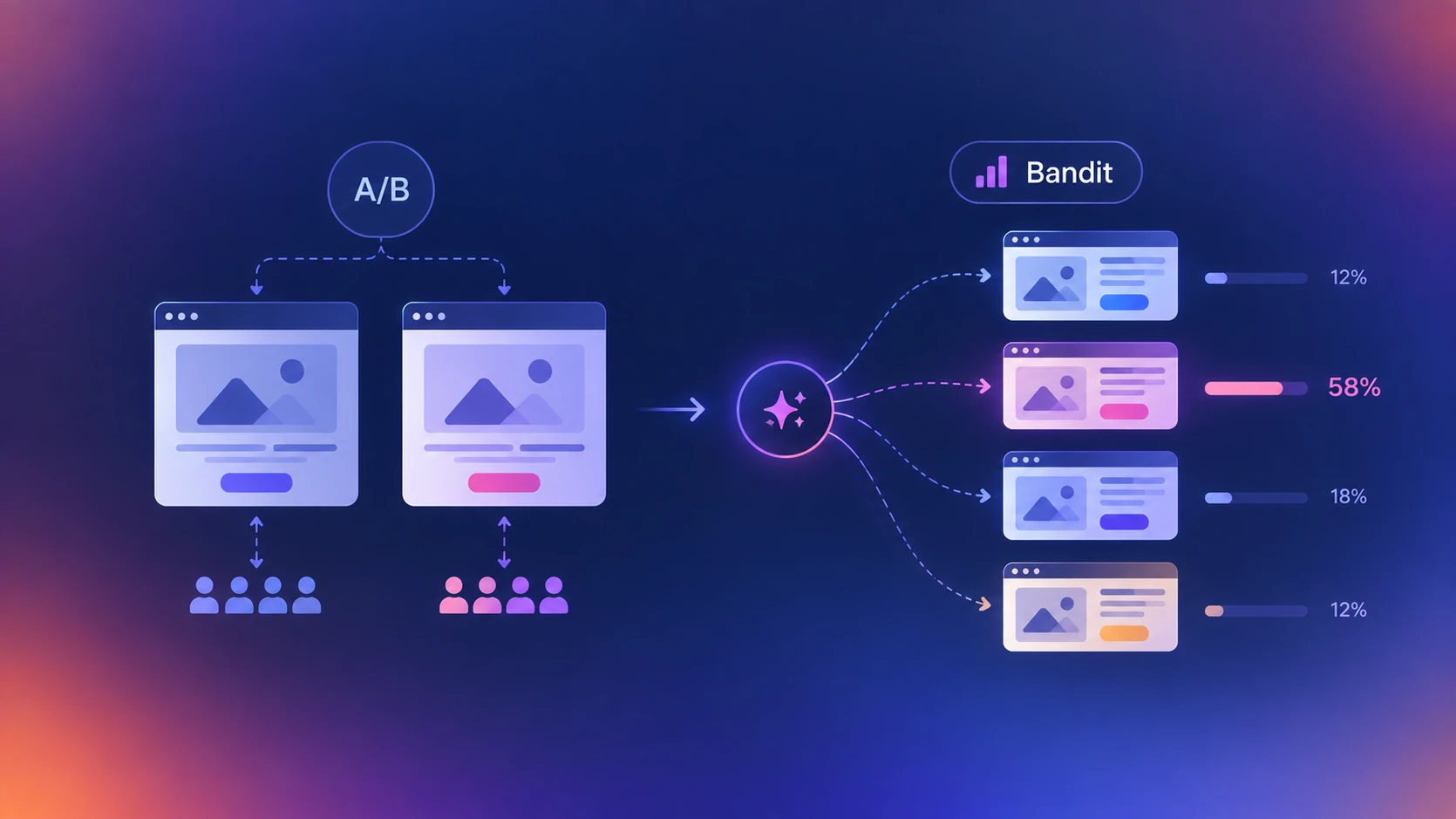





A/B testing and bandit testing solve the same problem — identifying the better variant — but they make different trade-offs between learning and earning. A fixed A/B test optimizes for a clean, defensible conclusion. A multi-armed bandit optimizes for the value you capture while you're still gathering evidence.
The Core Difference
A traditional A/B experiment holds allocation constant (typically 50/50), collects data until it hits a predetermined sample size, and reports a result at the end. By design, that means half your traffic keeps seeing the inferior variant for the entire test. A bandit algorithm continuously reallocates traffic based on live performance, sending more visitors to stronger variants and starving the weaker ones as the experiment runs.
Side by Side
| Dimension | A/B Test | Multi-Armed Bandit |
|---|---|---|
| Traffic allocation | Fixed (e.g., 50/50) | Adaptive — shifts toward winners |
| Primary goal | A clean, measurable result | Maximize conversions while learning |
| Opportunity cost | High — half of traffic to a loser | Low — losing variants starved quickly |
| Time to decision | Fixed by sample-size calculation | Continuous — no hard endpoint |
| Statistical clarity | High — clean significance test | Lower — shifting allocation complicates it |
| Best for many variants | Costly — needs large samples | Efficient — prunes weak arms early |
| Effect-size estimate | Precise | Less precise for losers |
When to Use an A/B Test
Reach for a fixed A/B test when precision and defensibility matter most:
- You need a precise effect estimate. A claim like "the new flow lifted conversions 6.2% (95% CI: 3–9%)" carries the rigor a finance or exec review expects. Bandits sacrifice precision on the losing variants because they deliberately stop sending them traffic.
- The decision is high-stakes and one-time. Major pricing changes, big redesigns, or year-long commitments deserve a result you can scrutinize.
- The insight has lasting value. When you're establishing a durable truth — say, whether social-proof placement matters — methodological rigor beats a short-term conversion bump.
- Signals arrive slowly. Long sales cycles or delayed conversions make early data noisy, and adaptive allocation can chase unreliable early signals.
When to Use a Bandit
Reach for a bandit when capturing value during the test beats statistical tidiness:
- Exposure to a loser is expensive. Time-boxed campaigns, promotions, ad variants, and seasonal pushes can't afford to send half their audience to weaker content.
- You have many variants to evaluate. Testing a dozen headlines through fixed A/B methodology demands enormous samples. Bandits prune weak contenders fast and concentrate traffic on the viable ones.
- Time is limited. A holiday promo or launch may end before a fixed test ever reaches significance. A bandit improves performance inside the window you actually have.
- Optimization is continuous, not a discrete project. Ongoing improvement maps naturally onto bandit algorithms rather than start-and-stop experiments.
How Bandits Actually Allocate
A bandit's intelligence lives in its selection strategy. Two common approaches:
- Epsilon-greedy — serves the current leader most of the time and reserves a fixed slice of traffic for random exploration. Simple, but its exploration isn't well-targeted.
- Thompson sampling — allocates traffic in proportion to each variant's probability of being best, so exploration naturally concentrates on genuine contenders.
Thompson sampling dominates modern implementations because it needs no exploration tuning and models uncertainty explicitly.
Where Surface AI Fits
Most teams shouldn't have to choose a methodology by hand for every change. Surface AI runs your site optimization as continuous multivariate bandit experiments — Thompson-sampling allocation that steers traffic toward whatever is converting best in real time, and AI-generated variant copy so you're never bottlenecked on producing things to test. It installs in about two minutes with a script tag or a framework integration (Next.js, Vercel, Netlify, Shopify). There's a free Starter plan and Pro at $79.99/month, which makes "always be optimizing" practical for lean teams, not just enterprises with a dedicated experimentation program. When you do need a clean, defensible read on a single high-stakes decision, you still run a deliberate fixed-horizon A/B test — the two approaches are complementary.
The Decision in One Line
Mature optimization teams use both: conventional testing for big, knowledge-generating decisions, and bandits for recurring, multi-option refinement. Modern platforms optimize live content continuously with bandit principles while preserving your ability to run a clean experiment whenever a definitive answer is the priority.