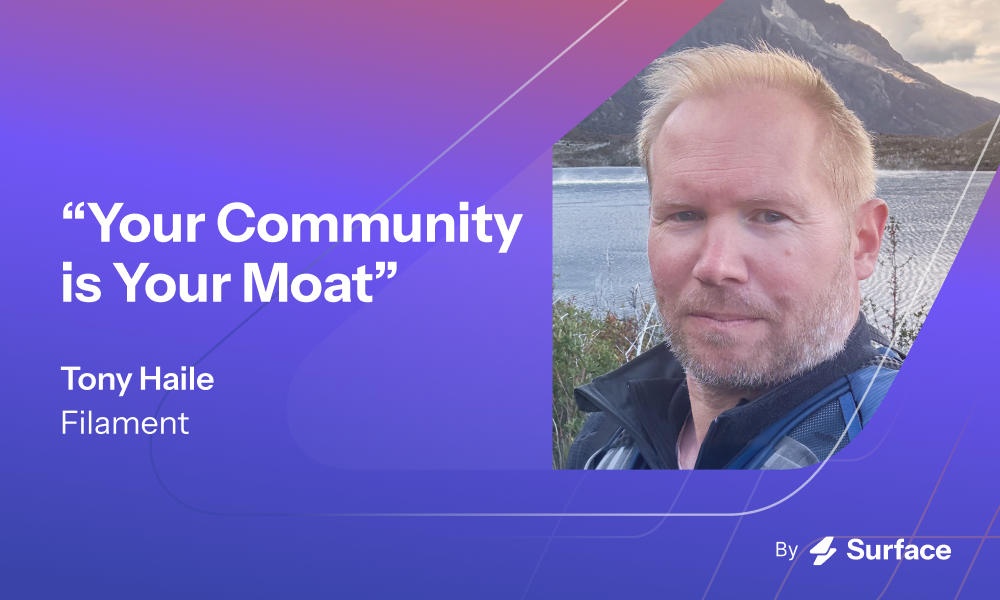





Recently I got to host Tony Haile at our Distribution Is Your Moat breakfast, although we went off in many different directions, we did get to the meet of the matter on what Tony's new company, Filament, is betting on when it comes to distribution.
His argument starts here: the internet isn't just changing, it's splitting into three. Not bifurcating -- trifurcating. "Bifurcation isn't good enough," he said. Here's the split:
So what is distribution for a chat app like Filament in this context?
Interesting. A market isn't just buyers. It's a network of buyers who converse with one another. The talking is a multiplier. This is, of course, another way of saying "community. But in order to maximize community Filament attempted to go after "conveners" -- the one person or org who can bring a thousand others with them.
It only sort of worked, and it was especially hard to convert an existing community. He told the story of Mixing Board (a professional network) -- 1,000 comms pros cobbled together on a free Slack -- and the organizers were more afraid of losing even one of them in a transition. They'd rather have a zombie community than an alive one on a better framework. Switching costs win.
What does work: building something new, and going after media companies specifically. They've got audiences, they run events, and their old business model is quietly being eaten by the same agents in split #1.
Tony has another thesis that he's working on building with Filament:
This is particularly relevant for me and our customers at Surface.
Tony's got a law for it -- basically, any group chat with at least one guy in it eventually becomes entirely about what everyone's vibe coding. Every professional group chat is an AI-transition support group now, because people are being reviewed on their AI fluency and quietly panicking that they have no idea where they stand. He described a CRO who swore his whole team "constantly uses AI" -- and when pressed, it was "I go to the text box instead of Google." You have no idea where you are on the curve.
And they can't learn in the open. You can't ask the dumb question at work without revealing your position. IT and legal have you locked to Copilot instead of the more performant SOTA stuff that would push you along the curve.
Even the CEOs are sneaking tools in -- one told Tony:
So Tony is picking a side in this fight for Filament to build upon: personal agents in multi-player as a corporate tool vs. corporate agent monoliths.
Personal agents are yours -- your context, your taste, your history. Corporate agents attempt to extract everything you and your colleagues know into a shared brain, and when you leave, you leave with nothing and it keeps everything. "It's like Severance," someone said. And the deeper problem: a giant corporate agent full of everyone's context averages out. Great for efficiency, terrible for the one weird idea that is going to outperform. Consensus machines don't innovate.
Filament's bet is personal agents that connect people, not corporate agents that replace them. His favorite version of this is the photocopier story -- the mRNA vaccine exists because Katalin Karikó happened to stand next to the right immunologist at a copier. His question: I can only sit next to three people at a conference. What if my agent -- one that actually knows what I've read and what I care about -- could go talk to a thousand agents while I talk to three people, and come back with the four I really need to meet?
That's a much better version of "here's my LinkedIn, go have a conversation with my shitty profile."
Two takeaways for me:
Feels like there's a real experiment here. Let's keep it moving.