.svg)





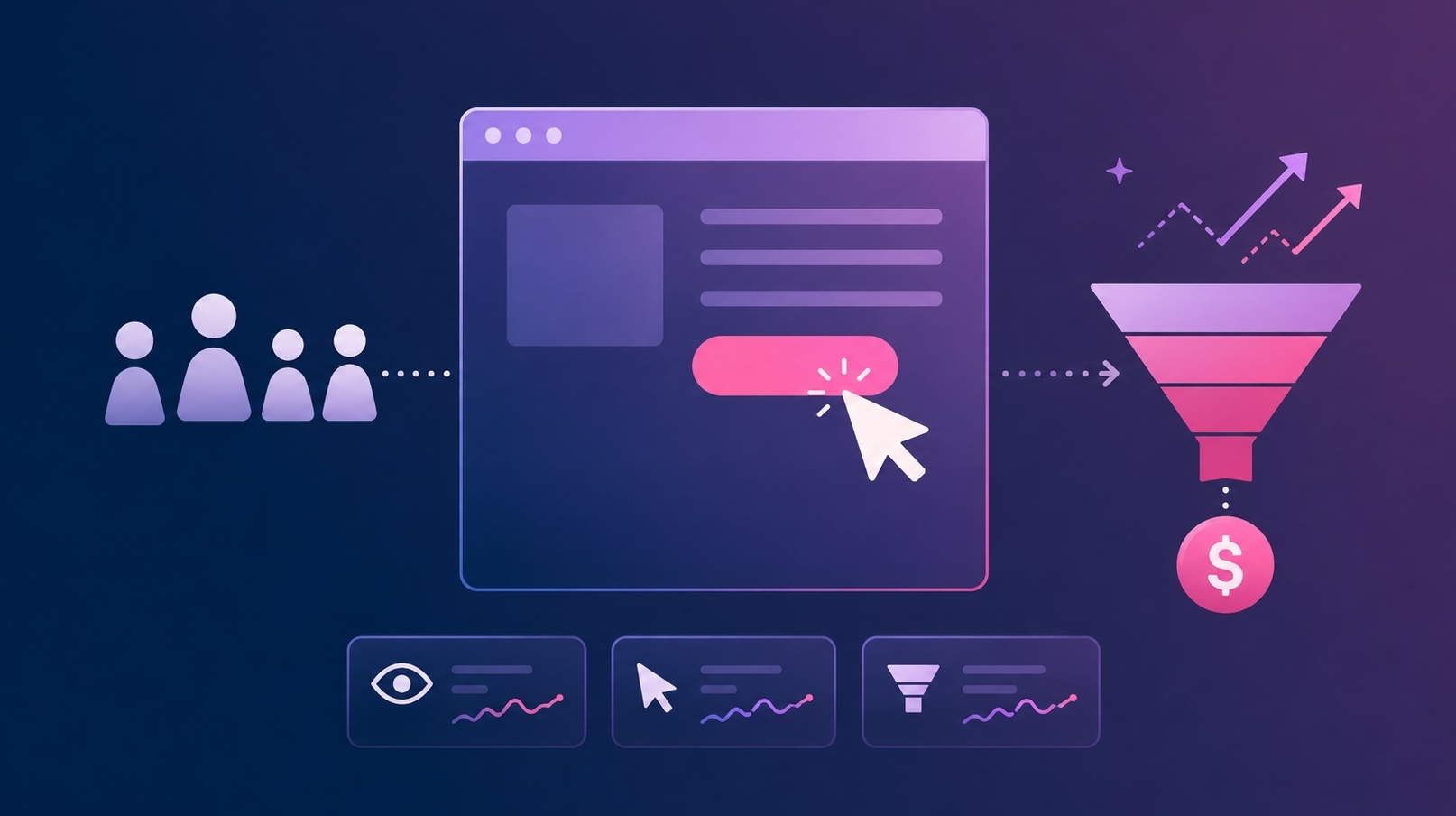
SaaS conversion optimization is different from e-commerce. You're not optimizing a single purchase — you're optimizing a funnel that might include a landing page visit, a free trial sign-up, product activation, and an upgrade to paid. Each stage has its own conversion rate, its own friction points, and its own optimization levers.
The teams that grow fastest are the ones that know which stage of the funnel to focus on. Here's how to find that focus.
The SaaS Conversion Funnel
A typical SaaS funnel has four key conversion points:
Each stage multiplies the one before it. If 100,000 visitors convert at 3% to trial, 30% to activation, and 25% to paid, you get 225 paying customers. Improving any one of those rates by 20% adds 45 more customers from the same traffic.
The question is: which stage gives you the most leverage right now?
Finding Your Biggest Lever
If Your Trial Sign-Up Rate Is Below 2%
Your landing page is the bottleneck. Visitors are arriving but not converting. Common causes:
Unclear value proposition
Visitors can't tell what your product does or why they should care within 5 seconds.
Too much friction
Long forms, required credit cards, confusing pricing pages.
Message mismatch
The landing page doesn't match the ad or link that brought them there.
Weak social proof
No logos, testimonials, or usage numbers to build trust.
This is the most straightforward stage to optimize because it's entirely within marketing's control and responds well to testing.
If Your Activation Rate Is Below 20%
People are signing up but not reaching the "aha moment." This is a product problem more than a marketing problem, but CRO principles still apply:
Simplify onboarding
Remove every step that isn't essential to reaching the first moment of value
Guide users to one action
Don't present a blank dashboard with twelve options. Point them to the single action that demonstrates core value.
Use progress indicators
The landing page doesn't match the ad or link that brought them there.
Weak social proof
Users who don't activate in the first 24 hours rarely come back. Email sequences that drive them back to the key action can recover 10–20% of otherwise lost trials.
If Your Trial-to-Paid Rate Is Below 15%
Users are experiencing the product but not paying for it. This usually means one of three things:
The product didn't deliver enough value during trial
They used it, but it didn't solve a real problem for them.
The pricing page is the problem
Confusing plan structures, hidden costs, or pricing that doesn't match the perceived value
No urgency to convert
If the free plan or trial gives them everything they need, there's no reason to pay
Pricing page optimization is one of the highest-ROI CRO activities for SaaS. Small changes — reordering plans, highlighting the recommended option, adding annual pricing with savings — can move trial-to-paid rates by 10–30%.
SaaS Landing Page Optimization
The SaaS landing page has unique requirements compared to e-commerce.
Hero Section
Your hero needs to answer three questions instantly:
What does this product do?
Be specific. "The collaboration platform" means nothing. "Real-time design collaboration for remote teams" means something.
Who is it for?
Name your audience. "For growth teams" or "For Shopify stores doing $1M+" immediately qualifies visitors.
What's the next step?
One CTA. "Start Free Trial" or "Book a Demo" — not both.
Social Proof Placement
SaaS buyers are skeptical. They've seen hundreds of landing pages. Your social proof needs to be:
Specific
"12,400 teams" not "thousands of customers".
Relevant
Logos they recognize from their industry.
Positioned early
Above the fold, not buried at the bottom.
Pricing Page
For SaaS, the pricing page is often the highest-intent page on the site — visitors who reach it are actively evaluating. Key optimization areas:
Number of plans
Three is the standard. More than four creates decision paralysis.
Plan naming
Names should reflect the buyer, not the feature set. "Starter, Growth, Enterprise" is clearer than "Basic, Pro, Ultra."
Feature comparison
Highlight what's different between plans, not what's the same.
Annual vs. monthly toggle
Always show annual first with the savings highlighted.
CTA per plan
Each plan should have its own CTA. "Start Free Trial" for self-serve, "Talk to Sales" for enterprise.
What to Test on SaaS Pages
Prioritize tests by expected revenue impact. Surface AI can help you zoom in on these elements in your specific pages.
High Impact
Headline and subheadline
Test different angles: problem-focused vs. benefit-focused vs. outcome-focused
CTA copy
"Start Free Trial" vs. "Get Started Free" vs. "Try It Free for 14 Days".
Social proof type
Customer logos vs. testimonial quotes vs. case study metrics vs. G2/Capterra ratings.
Pricing page layout
Plan order, recommended plan highlighting, feature comparison format.
Medium Impact
Hero image/video
Product screenshot vs. demo video vs. illustration vs. none.
Form fields
Email-only vs. email + name vs. email + name + company.
Trust signals
Security badges, money-back guarantees, "no credit card required".
Page length
Long-form with detailed features vs. short-form focused on one benefit.
Test with Caution
Free trial length
Affects downstream metrics (activation, conversion to paid) in ways that take weeks to measure.
Pricing
High stakes. Test carefully with holdout groups and longer observation windows.
Core value proposition
Important to get right, but requires enough traffic for statistical significance.
SaaS-Specific Metrics to Track
Beyond standard conversion rate, SaaS teams should monitor:
The SaaS CRO Playbook
Month 1–2: Foundation
- Set up analytics to track each funnel stage
- Identify your weakest conversion point
- Audit your landing page against the checklist above
- Run your first simple test on the headline or CTA of your highest-traffic page
Month 3–4: Systematic Testing
- Run 2–3 tests per month on your landing and pricing pages
- Segment results by traffic source — paid search visitors may respond differently than organic
- Start testing your pricing page layout and plan presentation (Surface AI is perfect for this).
Month 5–6: Expansion
- Expand testing to trial onboarding (activation rate)
- Build a test idea backlog scored by expected impact
- Begin testing across multiple pages simultaneously
Ongoing: Compound
- Maintain a consistent testing cadence
- Document every result in a shared knowledge base
- Review funnel metrics monthly and shift focus to the weakest stage
The Bottom Line
SaaS CRO is about finding and fixing the weakest point in your funnel. A 20% improvement at any single stage — visitor to trial, trial to active, active to paid — has the same effect on revenue. The key is knowing which stage to focus on now.
Start where the drop-off is worst, test systematically, and compound the gains over time. For teams that want to accelerate this process, Surface AI runs continuous multivariate experiments on your landing and pricing pages — automatically finding the highest-converting combinations without manual test management.